Consistere: Unterschied zwischen den Versionen
Aus KGS-Wiki
Sn (Diskussion | Beiträge) |
Sn (Diskussion | Beiträge) Keine Bearbeitungszusammenfassung |
||
| Zeile 1: | Zeile 1: | ||
{{DISPLAYTITLE:consistere}} | {{DISPLAYTITLE:consistere}} | ||
{{Legende Verb}} | {{Legende Verb}} | ||
{{Thumbnailbox|INHALT={{Wortwolke|1=consistere|2=}}}} | {{Thumbnailbox|INHALT={{Wortwolke|1=consistere|2=cumLA,sistereLA,consistGB}}}} | ||
{{Vokabelbox | {{Vokabelbox | ||
|Verwandte= | |Verwandte= | ||
|Bedeutungen= | |Bedeutungen= | ||
* stehenbleiben | |||
* haltmachen | |||
* sich aufstellen | |||
* bestehen aus | |||
|AndereSprachen= | |AndereSprachen= | ||
* Das englische '''consist''' bedeutet ebenfalls ''bestehen'' | |||
|Lernformen={{Stammformen | |Lernformen={{Stammformen | ||
|1=consistere | |1=consistere | ||
| Zeile 13: | Zeile 18: | ||
|lPerf=29}} | |lPerf=29}} | ||
|Wendungen= | |Wendungen= | ||
|Aufbau=}} | |Aufbau= | ||
{{Link-la|cum|12}} (zusammen) + {{Link-la|sistere}} (anhalten) | |||
}} | |||
| Zeile 53: | Zeile 60: | ||
|2PIA=consistitis|2PKA=consistatis|ImpP=consistite! | |2PIA=consistitis|2PKA=consistatis|ImpP=consistite! | ||
|3PIA=consistunt|3PKA=consistant}} | |3PIA=consistunt|3PKA=consistant}} | ||
{{Formentabelle/Verb|Tempus=Imperfekt | {{Formentabelle/Verb|Tempus=Imperfekt | ||
| Zeile 63: | Zeile 68: | ||
|2PIA=consistebatis|2PKA=consisteretis | |2PIA=consistebatis|2PKA=consisteretis | ||
|3PIA=consistebant|3PKA=consisterent}} | |3PIA=consistebant|3PKA=consisterent}} | ||
{{Formentabelle/Verb|Tempus=Futur I | {{Formentabelle/Verb|Tempus=Futur I | ||
| Zeile 73: | Zeile 76: | ||
|2PIA=consistetis | |2PIA=consistetis | ||
|3PIA=consistent}} | |3PIA=consistent}} | ||
== Formen mit Perfektstamm/PPP == | == Formen mit Perfektstamm/PPP == | ||
| Zeile 85: | Zeile 86: | ||
|2PIA=constitistis|2PKA=constiteritis | |2PIA=constitistis|2PKA=constiteritis | ||
|3PIA=constiterunt|3PKA=constiterint}} | |3PIA=constiterunt|3PKA=constiterint}} | ||
{{Formentabelle/Verb|Tempus=Plusquamperfekt | {{Formentabelle/Verb|Tempus=Plusquamperfekt | ||
| Zeile 95: | Zeile 94: | ||
|2PIA=constiteratis|2PKA=constitissetis | |2PIA=constiteratis|2PKA=constitissetis | ||
|3PIA=constiterant|3PKA=constitissent}} | |3PIA=constiterant|3PKA=constitissent}} | ||
{{Formentabelle/Verb|Tempus=Futur II | {{Formentabelle/Verb|Tempus=Futur II | ||
| Zeile 105: | Zeile 102: | ||
|2PIA=constiteritis | |2PIA=constiteritis | ||
|3PIA=constiterint}} | |3PIA=constiterint}} | ||
== Weblinks == | == Weblinks == | ||
Aktuelle Version vom 25. Februar 2026, 18:10 Uhr
| Hinter jedem grammatischen Phänomen steht in eckigen Klammern die Campus-Lektion in der es eingeführt wird: [42]. |
- Lernformen
- consistere[17], consisto, constiti[29]Bei Verben lernen wir die vier Stammformen: Infinitiv (consistere), 1. Person Singular Präsens Indikativ Aktiv (consisto), 1. Person Singular Perfekt Indikativ Aktiv (constiti) und PPP (Partizip Perfekt Passiv, gibt es hier nicht). Aus dem Infinitiv und der 1. Person Präsens kann man sich den Präsensstamm und die Konjugationsklasse erschließen, die vorgeben, wie die Formen im Präsens, Imperfekt und Futur I konjugiert werden. Indem man von der 1. Person Singular Perfekt Indikativ Aktiv das -i abschneidet, erhält man den Perfektstamm, der vorgibt, wie die Aktivformen im Perfekt, Plusquamperfekt und Futur II konjugiert werden. Das PPP gibt vor, wie die Passivformen im Perfekt, Plusquamperfekt und Futur II konjugiert werden. Wenn kein PPP vorhanden ist, deutet das darauf hin, dass dieses Verb keine Passivformen bildet.
- Aufbau
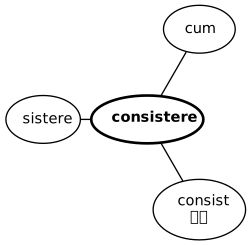
- cum[12] (zusammen) + sistere (anhalten)
- Bedeutungen
- stehenbleiben
- haltmachen
- sich aufstellen
- bestehen aus
- In anderen Sprachen
- Das englische consist bedeutet ebenfalls bestehen
Infinite Formen
| Aktiv | |
|---|---|
| Präsens | consistere |
| Perfekt | constitisse |
| Partizip Präsens Aktiv | consistens, consistentis |
|---|
| Gerundium | Gerundivum |
|---|---|
| consistendi | consistendus/a/um |
Formen mit Präsensstamm
| Person | Indikativ Aktiv | Konjunktiv Aktiv | Imperativ |
|---|---|---|---|
| 1. Person Singular | consisto | consistam | |
| 2. Person Singular | consistis | consistas | consiste! |
| 3. Person Singular | consistit | consistat | |
| 1. Person Plural | consistimus | consistamus | |
| 2. Person Plural | consistitis | consistatis | consistite! |
| 3. Person Plural | consistunt | consistant |
| Person | Indikativ Aktiv | Konjunktiv Aktiv |
|---|---|---|
| 1. Person Singular | consistebam | consisterem |
| 2. Person Singular | consistebas | consisteres |
| 3. Person Singular | consistebat | consisteret |
| 1. Person Plural | consistebamus | consisteremus |
| 2. Person Plural | consistebatis | consisteretis |
| 3. Person Plural | consistebant | consisterent |
| Person | Indikativ Aktiv |
|---|---|
| 1. Person Singular | consistam |
| 2. Person Singular | consistes |
| 3. Person Singular | consistet |
| 1. Person Plural | consistemus |
| 2. Person Plural | consistetis |
| 3. Person Plural | consistent |
Formen mit Perfektstamm/PPP
| Person | Indikativ Aktiv | Konjunktiv Aktiv |
|---|---|---|
| 1. Person Singular | constiti | constiterim |
| 2. Person Singular | constitisti | constiteris |
| 3. Person Singular | constitit | constiterit |
| 1. Person Plural | constitimus | constiterimus |
| 2. Person Plural | constitistis | constiteritis |
| 3. Person Plural | constiterunt | constiterint |
| Person | Indikativ Aktiv | Konjunktiv Aktiv |
|---|---|---|
| 1. Person Singular | constiteram | constitissem |
| 2. Person Singular | constiteras | constitisses |
| 3. Person Singular | constiterat | constitisset |
| 1. Person Plural | constiteramus | constitissemus |
| 2. Person Plural | constiteratis | constitissetis |
| 3. Person Plural | constiterant | constitissent |
| Person | Indikativ Aktiv |
|---|---|
| 1. Person Singular | constitero |
| 2. Person Singular | constiteris |
| 3. Person Singular | constiterit |
| 1. Person Plural | constiterimus |
| 2. Person Plural | constiteritis |
| 3. Person Plural | constiterint |
Weblinks